Some areas and figures in the Hallowell mural went in solidly after long and careful planning. However, the birds near the top of the mural started as an abstract concept in my head–I wanted birds but somehow abstracted birds, perhaps out of folded paper, flying in front of a realistic scene. I did sketch in the drawing pad, which is the only sane way to plan a section of a mural. But what can I say, sometimes I like to just jump in with paint and see what happens.
These are some phases of how these birds evolved over time. I am pretty sure they are almost done. Sad to see some of the birds that fly in then fly out again, but the mural has to be the final judge of what stays. And as I have found, something that disappears from one painting often shows up in another.
Here I have local Hallowellians of various periods of time standing, sitting and climbing the scaffolding that was erected around the 36 foot granite “Faith” sculpture that was carved here in Hallowell in the 1880’s.
This is a section near the top of the mural. I have been going over various parts to pull up details and add finishing touches. This is Benjamin Vaughan and on the right is a small section of the scene depicting the midwife Martha Ballard delivering a baby.
Here I include a representation of some of the many generations of men and women who have served our country in the many wars. This is some of the men…and I have important woman elsewhere, in a section still being painted.
This is the large “Faith” sculpture that was carved in Hallowell in the late 1880’s. She is 36 feet tall, carved from local granite and she is the largest granite sculpture in the United States. She is the centerpiece figure of the National Monument to the Forefathers, in Plymouth Massachusetts.
Here I was adding or layering the granite textures. I had build the forms of her head with simple gray tone paint but that makes her looks like dull concrete. So to build a bright, clear grained, Hallowell granite I splattered many layers of lighter paints on top until it had the density of texture and natural stone-ness that I wanted.
The 36-foot figure of Faith was based on a 9-foot plaster model by William Rimmer in 1875,[6] that was enlarged and altered by Joseph Edward Billings and a sculptor named Perry (probably John D. Perry). The subsidiary statues were executed by area sculptors including Alexander Doyle, Carl Conrads, and James H. Mahoney.
This is a section at the top center of the 24 x 29 foot mural, depicting a colonial period woman tending the fields with her daughter. Hallowell was a major international shipping port on the Kennebec River, so at any given time a good half of all the boys and men in the town were off at sea. This, of course, mean that the women tended to everything to maintain and build a community. This is why I have place this pregnant woman and her daugher prominently at the top of the mural.
I needed to repaint the mermaid in the Hallowell Mural. So here is a video of the redo.
The mermaid is in the mural to reference our very own Slate’s restaurant which burned a number of years ago. And the Slates mermaid rose from the ashes like the proverbial phoenix.
This is Hannah Dole. I am including her in the Hallowell Mural.
So, what does it take to include a figure in a history mural?
Fortunately, Kate Trembly had an old portrait of Hannah Dole for me to work from, for likeness. However, my job is not just copying an old portrait onto the mural. My job is to animate her, bring her to life, and fit her into the “plot” of the mural. And while doing so, show her intelligence and the kindness in her soul.
Hannah Dole is going in the mural as she might have appeared in 1830. One of my first tasks is researching clothing of the period. I need to be careful to get this accurate to the time.
Would she be wearing the latest fashion? Or slightly older clothing? Modest or flamboyant?
I focused on clothing from the Late Regency and mid Antebellum periods in America— and pre Victorian period which began in 1837. Queen Victoria inspired a big change in clothing style again. But I am looking for clothes from roughly late 1820’s to 1830.
Women’s clothing changed a lot from the mid to late Regency period with the empire silhouette—1812-1820’s. Here is a very flowing empire style dress. A flowing style that accentuated the bust, neck and shoulders, with flowing, draping fabric.
Empire dress
Then sleeves began to get large just below the shoulder. Hairstyles changed. The bodice changed to a much more structured fit with waist stays to cinch in and accentuate the waist.
Antebellum, circa 1830
The type of fabric is very important too. You paint stiff fabric in a different manner than soft and flowing, draping fabric. Also, for what I need Hannah Dole would be wearing a dress she might wear to walk around town, not a fancy dinner gown. So lots of research.
The puff of the leg of mutton or gigot sleeves, shifted down the arm a few years later so I have to watch for details like this to make sure I hit the right time frame of fashion. And these large sleeves disappeared completely with the coronation of Queen Victoria and the advent of a new more sedate style.
Undergarments are supremely important. The dress she is wearing needs the support of the undergarments to fit right. So I need to see what those undergarments looked like. In this picture, the woman is wearing 3 petticoats and a small layered bustle to give the dress its volume. And full leg of mutton sleeves needed padding to maintain their puff.
petticoats
Here is a fascinating youTube video on the undergarments worn in the 1830’s.
For the mural I am having Hannah Dole in a different pose from the portrait we have of her. So I used another model to pose how I wanted. I blocked in this figure and then used that head form as the starter recipe, if you will, to modify into how I wanted Hannah Dole to look. Changed the nose, the chin the cheekbones, etc. So this….
…became this.
Hannah Dole, so far…much work to do.
And Jen posed so I could get some arms to use for this pose. But that is tomorrow’s work.
There are over 100 figures in the mural and each one presents his or her own challenges to paint them right.
More on why I am including Hannah Dole, and specifically in 1830, in another post.
How can you represent our fine Hallowell without showing music, dance and the arts? I have just begun the arts section and this is part of the larger than life figures that will form the backdrop for the musicians and dancers.
NOTE: 11/14/21, this section of the Hallowell mural is now completely repainted. So goes art.
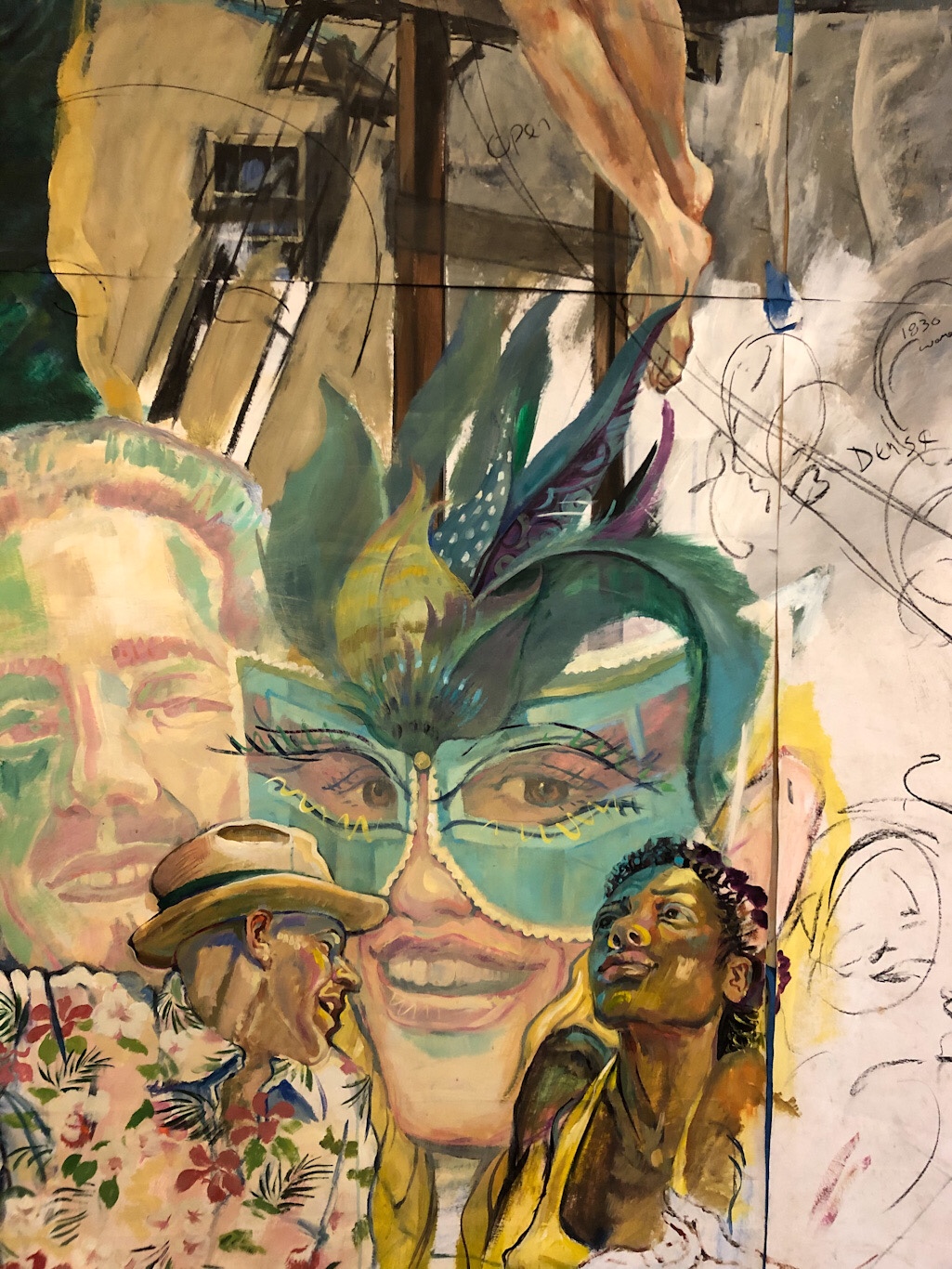
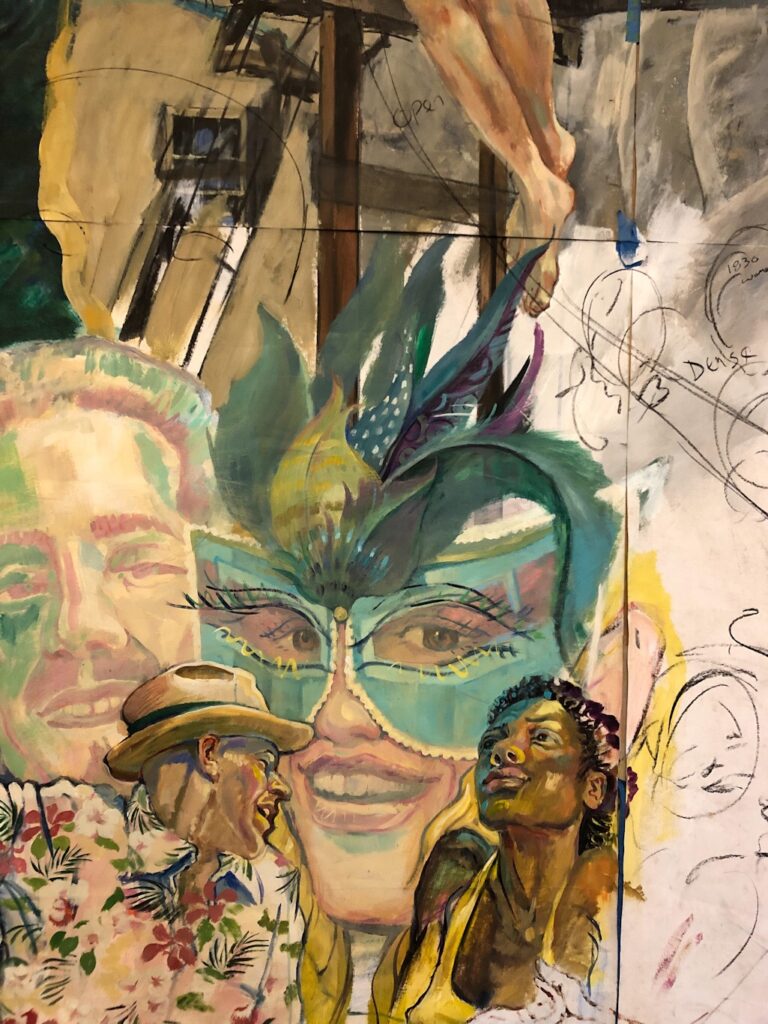
Here are some more progress photos of other parts of the mural.
This older gentleman is Judge Richard Rice. In the 1850’s he and some other ingenious folks built the first steam powered car in Maine–built right here in Hallowell. Here I show Judge Rice on his triumphant trip across town on the first car.
Also, an update of one of the seamen in the mural and a mother and daughter tending the fields.
Martha Ballard was a midwife and caregiver for most of the residents of Hallowell in the late 18th and early 19th centuries. She delivered close to 1000 babies, in a region with a population of only several thousand. She was supremely important to the origins of our town.
She kept a diary of her doctoring. She became well known today when her diary was discovered and published.
A study and progress pictures of Martha Ballard in the Hallowell Mural.
Spent the day refining some of the figures and roughing in a few more. This is Dr. Benjamin Vaughan, a notable patriot, a well read man with a library only rivaled by that of Harvard of the time. Here he is penning a letter to President Thomas Jefferson, one of the many important people with whom he corresponded for many decades.
Today, Thursday is another open studio afternoon, 2-4 so stop by to see the mural progress.
a Hallowell Mural pencil study from this morning for the figurehead I will be working on today.
Captain Drew was a well known sea captain from our bend in the river. As with many men from our town Captain Drew sailed to all ports of the world.
As well as a sea town, Hallowell was also a town of letters and learning. Captain Drew was a man of letters himself, penning articles of his many voyages for the newspaper under the moniker, the Kennebecker, from 1876 to 1889.
Captain Drew’s father was a local ship carver and he will be in the mural working on this figurehead.
Work is progressing well on the Hallowell Mural Project. Had several visitors on yesterday’s open mural studio Thursday. Here are some photos of progress. Some initial block-ins of figures. I am working on the top of the mural—adding in some key historical figures. You will see these scenes come into focus over the next days.
Martha Ballard, the midwife, well known for the journal she kept.
Dr. Benjamin Vaughan, here seen writing a letter to Thomas Jefferson with whom he corresponded for many years.
James Mathews, who escaped slavery in South Carolina, made his way north stowed away on a ship from Charleston to Boston and made his way to Hallowell with help along the underground railroad. He had a troubled life but his account of his years as an enslaved person became important in the national Abolitionist movement.
The upper left of the mural represents all the seamen, mostly men, young and old, who went to sea from the home shores of Hallowell.
And the women stayed home to tend the crops, raise the families and build the home communities.
Here are a few details of various parts of the Hallowell Mural. I’ve been working on the upper third of the 28 foot (vertical) mural. The upper left will deal with Hallowell’s maritime history—shipping, ship building.
This is a color study of one of the figures who might go in the mural, but more importantly, he is my paint and canvas test to see how the materials will hold up on the wall.
The method I am using for this mural was developed by the Philadelphia Mural Arts program, for their, literally, thousands of exterior murals.
It is called the Polytap Method, or sometimes the parachute cloth method,. It uses a super tough non-woven fabric called Polytab. And when you paint on it with exterior rated acrylic paints is creates an indestructible surface.
I painted this sample to test it anyway, because it is always good to run your own tests of materials you use.
This sample has been out in sun, rain and subjected to freezing temps. And I have been abusing the canvas too–wrenching it around to make sure the paint holds up.
Looks just wonderful. This mural will be up for decades without even a blemish.