Blog

  • the birds, the birds, the birds

    the birds, the birds, the birds

    Some areas and figures in the Hallowell mural went in solidly after long and careful planning. However, the birds near the top of the mural started as an abstract concept in my head–I wanted birds but somehow abstracted birds, perhaps out of folded paper, flying in front of a realistic scene. I did sketch in the drawing pad, which is the only sane way to plan a section of a mural. But what can I say, sometimes I like to just jump in with paint and see what happens.


    These are some phases of how these birds evolved over time. I am pretty sure they are almost done. Sad to see some of the birds that fly in then fly out again, but the mural has to be the final judge of what stays. And as I have found, something that disappears from one painting often shows up in another.

  • the scaffolding

    the scaffolding

    Here I have local Hallowellians of various periods of time standing, sitting and climbing the scaffolding that was erected around the 36 foot granite “Faith” sculpture that was carved here in Hallowell in the 1880’s.

  • Pushing toward finish

    Pushing toward finish

    This is a section near the top of the mural. I have been going over various parts to pull up details and add finishing touches. This is Benjamin Vaughan and on the right is a small section of the scene depicting the midwife Martha Ballard delivering a baby.

  • those who served

    those who served

    Here I include a representation of some of the many generations of men and women who have served our country in the many wars. This is some of the men…and I have important woman elsewhere, in a section still being painted.

  • Adding Granite textures

    Adding Granite textures

    This is the large “Faith” sculpture that was carved in Hallowell in the late 1880’s. She is 36 feet tall, carved from local granite and she is the largest granite sculpture in the United States. She is the centerpiece figure of the National Monument to the Forefathers, in Plymouth Massachusetts.

    (https://en.wikipedia.org/wiki/National_Monument_to_the_Forefathers)

    Here I was adding or layering the granite textures. I had build the forms of her head with simple gray tone paint but that makes her looks like dull concrete. So to build a bright, clear grained, Hallowell granite I splattered many layers of lighter paints on top until it had the density of texture and natural stone-ness that I wanted.

    The 36-foot figure of Faith was based on a 9-foot plaster model by William Rimmer in 1875,[6] that was enlarged and altered by Joseph Edward Billings and a sculptor named Perry (probably John D. Perry). The subsidiary statues were executed by area sculptors including Alexander Doyle, Carl Conrads, and James H. Mahoney.

  • farm woman and daughter

    farm woman and daughter

    This is a section at the top center of the 24 x 29 foot mural, depicting a colonial period woman tending the fields with her daughter. Hallowell was a major international shipping port on the Kennebec River, so at any given time a good half of all the boys and men in the town were off at sea. This, of course, mean that the women tended to everything to maintain and build a community. This is why I have place this pregnant woman and her daugher prominently at the top of the mural.

  • Mother and Child, 2021

    Mother and Child, 2021

    digital iPad drawing

  • Art, a 5 step program

    Art, a 5 step program

    Art needs a strange alchemy of several factors.   Imagination, skill, content, vision and perhaps, as some today are saying, empathy.  None of these elements by itself is enough to become Art in CAPS.

    Imagination won’t suffice alone.  Without skill riding shotgun, even the most imaginative idea runs the risk of poor execution, and perhaps wasting that good idea. A loud imagination with no skill is often a naive tantrum.

    Skill is not enough either.  Mastering paint skills, while important, by itself can merely seem like looking for approbation or proving one’s self by some sort of school day gold stars standards.

    Content, while important, both small and grand content—quiet stories and dramatic stories—is not enough and may smell weakly sincere or rankly of propaganda.

    Vision can sometimes pull a piece up to lofty heights simply because of the unique quality of the life-view the artist instilled in the piece—in spite of weak skills and plodding imagination or execution—but this is rare, not to be counted on and vision often is a wondrous soap bubble that will not last.

    Empathy for your subject and, yes, empathy for your viewers is interesting as an element of art.  By empathy, do I mean all art should be kind or gentle, non-confrontational?  No, but it does mean that instead of kicking in your viewers teeth, we as artists should try to give the viewer a hand to enter our work.  Make them not the enemy initially, but give them a key or door into the subject.  Confrontational movies often do this in rough story lines by giving us a neutral normal character we can hang onto.  That character brings us into the rough story, and she may be shocked by the scene the way we are.  That is giving us an empathetic entrance into the scene.  But again, by itself this may mean kindness, consideration and may make us a polite society but does not guarantee Art.

    So we need a combination of at least few of these these things.  If a piece has all five elements then it might, just might, be a masterpiece to last a few years or more.

    One more thing that is important and I am not sure it is as much a part of execution of a piece as a product of the resulting art—the art needs to be relevant to our today, our NOW.  It can be big art or small but it needs to talk to live people today, engage them with the visual language we have today. If not, it is merely nostalgia for another time.

    That visual language is in constant flux.  Today the paint world’s visual language seems to be heading back to appreciation of skills of rendering real things.  I think this is fabulous.  Painting a real looking figure is a wonderful skill. (From the artist’s perspective, developing these skills is intoxicating.  It is just plain fun to be able to scrub some paint around and find you have a real looking arm or leg.)

    However, and this is a big however, the most relevant art today is not ignoring the masterful work created during the 20th century.  To negate the discoveries in art of the big and little masters of the 20th century “modern” movement is to blind yourself as an artist.  Maybe you didn’t like the work of the modern art century.  But from an artist’s perspective there were very inventive doors opened that can and indeed, should be influencing us as we paint in this new century.

    Yes, Pollock, Rothko and Toby should be getting into our heads and finding their way out our brushes…even if we want to paint a naturalistic figurative scene.  We should not ignore the lessons of Hoffman, Kandinsky, Stella, Hockney, Freud, Warhol…the list goes on…

    Picasso and Braque opened a door to what came to be called cubism—a new way of looking at an object and painting it, not by creating illusionistic space but by making a brand new honestly 2 dimensional object on the 2 dimensional flat canvas that quoted the original thing, if you will.  I don’t think that space beyond that cubist door has been fully explored.  The great modern master, Nicolas Uribe, is one who has worked with the idea to create some fabulous things…though in a sense I feel his direction is more an experiment of merging time frames rather that merging understood concepts of a form.  But hey, not a critique, it is cool to see new things.  And Nicolas’ hands are pure, unadulterated wondrous magic.

    I’m sure I missed stuff but enough for now…off to paint, seeya

    the painting detail above is from my oil, I Fear What You Fear.


  • Amaya at coffee shop

    Amaya at coffee shop

    Digital Ink Drawing
    16 x 12 inches

  • Signature Style

    Signature Style

    Some artists perfect a signature style.  Their work fits into one general theme or look, and as their work matures that style is honed into perfection.

    I have tried to do this but I can’t pin my head down.  It wants to try different things.  It doesn’t mean I don’t create true feelings, but for me one piece needs to be painted one way, while another screams to be brought to life in another form.

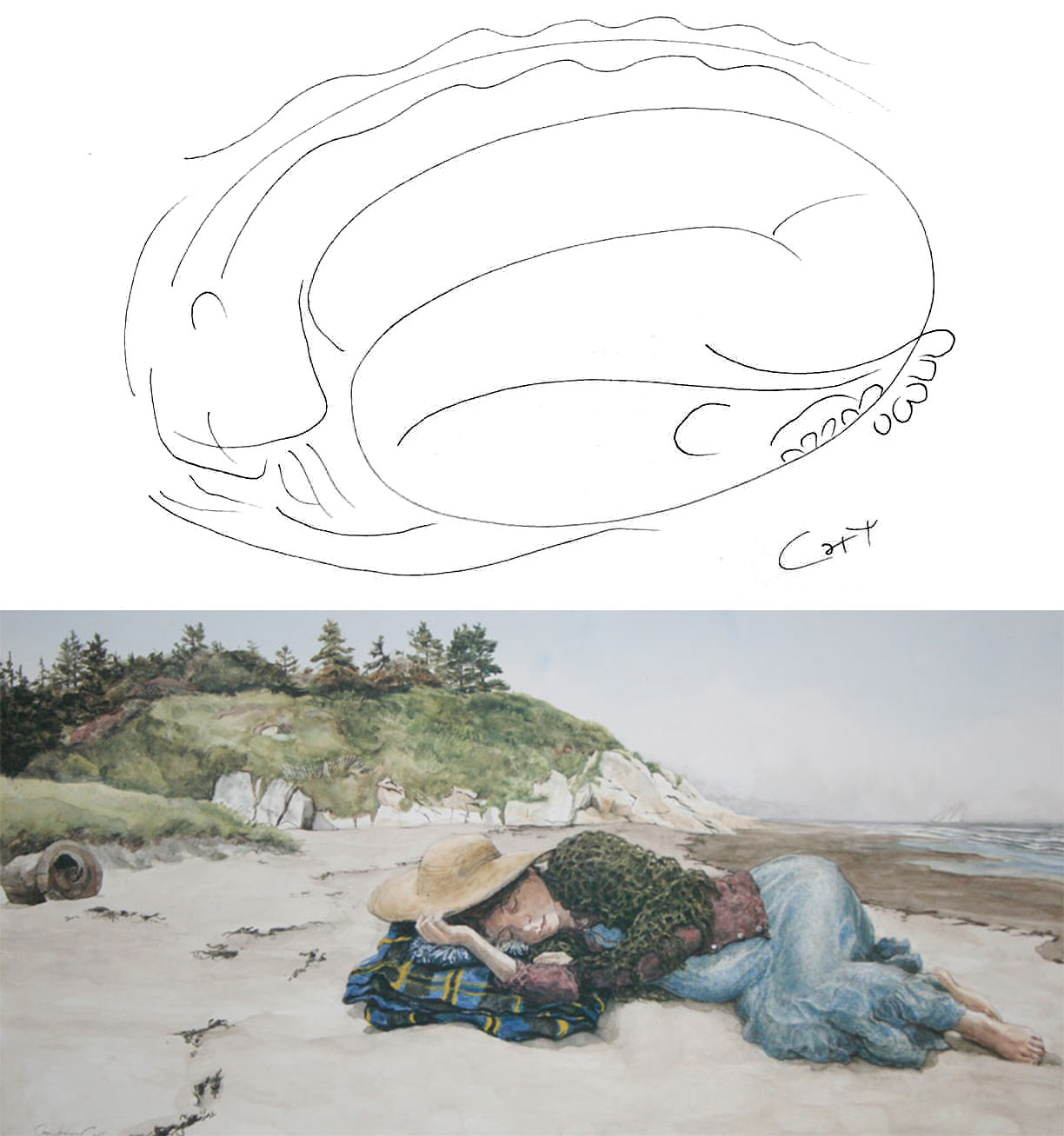
    For example, for me both these pieces come from the same place.

  • Celebrity Bar Mural

    Celebrity Bar Mural

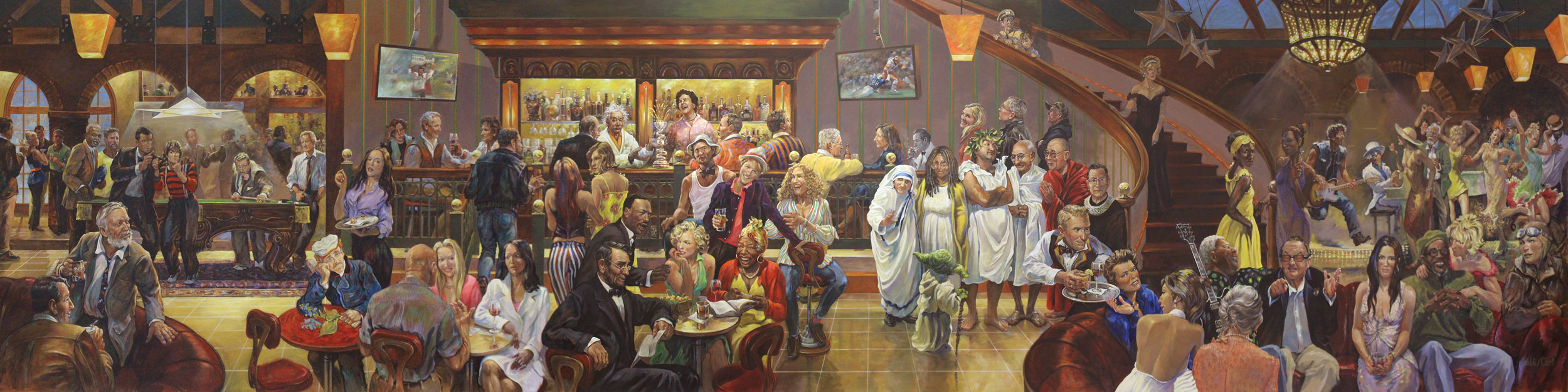
    A 9 x 34 foot mural of celebrities in a bar. The mural is at Patsy’s Restaurant in Tysons Corner outside Washington, D.C. Painted in 2019 with fellow mural artist John Gable.  Patsy’s Great American Restaurant.

  • Carnival Mural

    Carnival Mural

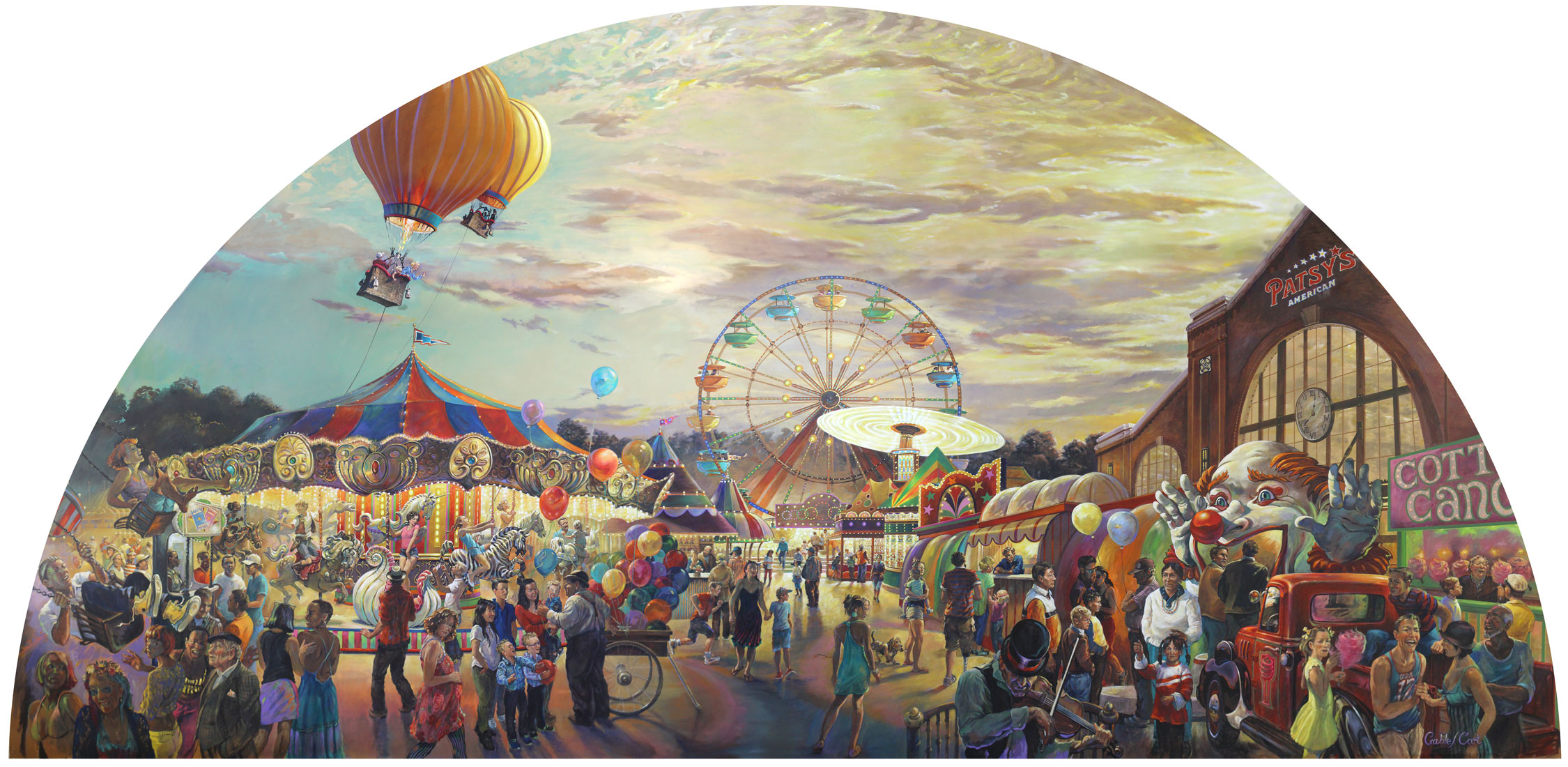
    Carnival Mural, Washington D.C. created by Chris Cart and John Gable.

    A 16 by 34 foot mural created with artist John Gable for Patsy’s Great American Restaurant in Tyson’s Corner, outside of Washington D.C.

  • Mermaid redo

    Mermaid redo

    I needed to repaint the mermaid in the Hallowell Mural. So here is a video of the redo.

    The mermaid is in the mural to reference our very own Slate’s restaurant which burned a number of years ago. And the Slates mermaid rose from the ashes like the proverbial phoenix.

  • Hannah Dole, Hallowell Mural

    Hannah Dole, Hallowell Mural

    This is Hannah Dole. I am including her in the Hallowell Mural.

    So, what does it take to include a figure in a history mural?

    Fortunately, Kate Trembly had an old portrait of Hannah Dole for me to work from, for likeness. However, my job is not just copying an old portrait onto the mural. My job is to animate her, bring her to life, and fit her into the “plot” of the mural. And while doing so, show her intelligence and the kindness in her soul.

    Hannah Dole is going in the mural as she might have appeared in 1830. One of my first tasks is researching clothing of the period. I need to be careful to get this accurate to the time.

    Would she be wearing the latest fashion? Or slightly older clothing? Modest or flamboyant?

    I focused on clothing from the Late Regency and mid Antebellum periods in America— and pre Victorian period which began in 1837. Queen Victoria inspired a big change in clothing style again. But I am looking for clothes from roughly late 1820’s to 1830.

    Women’s clothing changed a lot from the mid to late Regency period with the empire silhouette—1812-1820’s. Here is a very flowing empire style dress. A flowing style that accentuated the bust, neck and shoulders, with flowing, draping fabric.

    Empire dress

    Then sleeves began to get large just below the shoulder. Hairstyles changed. The bodice changed to a much more structured fit with waist stays to cinch in and accentuate the waist.

    Antebellum, circa 1830

    The type of fabric is very important too. You paint stiff fabric in a different manner than soft and flowing, draping fabric. Also, for what I need Hannah Dole would be wearing a dress she might wear to walk around town, not a fancy dinner gown. So lots of research.

    The puff of the leg of mutton or gigot sleeves, shifted down the arm a few years later so I have to watch for details like this to make sure I hit the right time frame of fashion. And these large sleeves disappeared completely with the coronation of Queen Victoria and the advent of a new more sedate style.

    Undergarments are supremely important. The dress she is wearing needs the support of the undergarments to fit right. So I need to see what those undergarments looked like. In this picture, the woman is wearing 3 petticoats and a small layered bustle to give the dress its volume. And full leg of mutton sleeves needed padding to maintain their puff.

    petticoats

    Here is a fascinating youTube video on the undergarments worn in the 1830’s.

    For the mural I am having Hannah Dole in a different pose from the portrait we have of her. So I used another model to pose how I wanted. I blocked in this figure and then used that head form as the starter recipe, if you will, to modify into how I wanted Hannah Dole to look. Changed the nose, the chin the cheekbones, etc. So this….

    …became this.

    Hannah Dole, so far…much work to do.

    And Jen posed so I could get some arms to use for this pose. But that is tomorrow’s work.

    There are over 100 figures in the mural and each one presents his or her own challenges to paint them right.

    More on why I am including Hannah Dole, and specifically in 1830, in another post.

  • Don’t call me a Fascist.

    Don’t call me a Fascist.

    Dear Mr. President,

    Don’t call me a fascist on this 4th of July. I am an American.

    People are crying, “Something is wrong. All is not right.” I have listened. You have not.

    If my black friends and brothers are saying equality is not here, I will listen. If my gay brother is in pain, I will listen. If my Latino brother says all is not well, I will listen. If my wife and my daughter and my sister say equality is not here, I will listen. I love them; I trust them, so I will listen — as they would listen to me, if I said all is not right, because they love and trust me in return. You have not listened.

    If my family is not content, how can I sit idle and be content? I can not.

    The honest American fight is to make life better for others, not simply to take for myself. By lifting each other up, we help lift up us all. That is the American spirit from our greatest of generations.

    Our imperfect founding fathers wrote brilliant documents that created a country, not as a fortress of immovable stone, but as a path. It is this path we have been striving to properly find and then follow for 12 score and 2 years—amending our route when we strayed from the path toward equality. Our country has been deeply flawed in the living of it — and yet, the ideal we strive for is beautiful.

    It seems I come from abolitionist Quaker stock. My ancestors trace also to Robert Lee. So this fight of equality is in me. I fought to keep people enslaved, and I fought with blood and sinew to help free them. Do not tell me I am not America. I am a piece of this land, the good and the bad. Don’t tell me I am un-American because I speak out for freedom and equality today. I know this fight of old. We will win again. We will win again, because it is the good fight.

    And yet, today you call me a fascist? Is this because I love equality and justice for all, enough to fight for it?

    Most sincerely, on this 4th of July,

    an American